Quimper
Collection 1 > France

Quimper
Quimper was the location for several “faienceries”, of which the oldest and (for piggy banks) most important is the Grande Maison HB-Henriot. Famous artists and potters played a role in the history, beginning around 1690, of what has come to be called Quimper Faïence to distinguish it from other French or Breton pottery. The Quimper name includes more brands than just HB Henriot.
We start this page with the history of HB and Henriot, who were first major competitors and much later merger tot form HB-Henriot.
History of HB Henriot
- The HB brand was registered in 1771, H van Hubaudière and B van Bousquet (the founder of the first faïencerie in 1690). In 1776 a split takes place and Henriot is created, followed by a third faïencerie by the family called Porquier.
- 1870 is an important year for the Quimper tradition, because that is the start of the design of the famous Breton peasant and peasant woman on pottery. A design by Alfred Beau (Porquier).
- In 1913 Henriot acquires competitor Porquier and takes over all copyright and molds (hence one similar mould for the pig piggy banks of the various faïenceries).
- Between 1922 and 1932, Jules Verlingue and Louis Bolloré registered the brand 'VB Normandie'. Jules Verlingue was director of HB Quimper and later owner of his own faience studio. Louis Bolloré was a business partner.
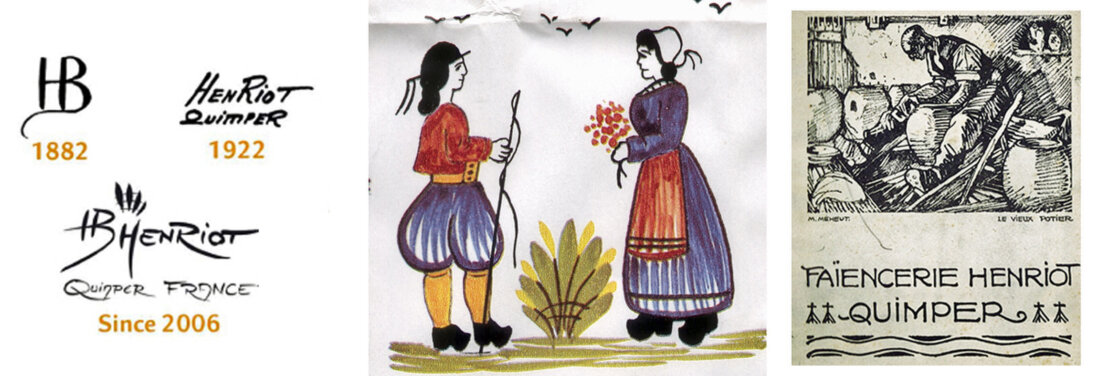
- Between 1920 and 1940, HB and Henriot are 'leading' when it comes to Quimper pottery. Henriot carries the HR brand (H from Henriot and R from Riou, Henriot's wife at the time). HB uses HB as a brand. Which leads to confusion (even now). Through a legal procedure, Henriot is ordered from 1922 on to replace the HR brand by Henriot in full.
- In 1968 HB and Henriot merged to form the well-known HB-Henriot. For dating purposes, it is important to note that the names HB and Henriot continued (with a special signature with a "half-wreath" beneath the name) to be used as trade names (though no longer as brand names), in all likelihood until 1983.
- In 1983 the company almost went bankrupt and a number of restarts took place.
- Today, Faïencerie de Quimper HB-Henriot produces in Locmaria, a suburb of Quimper. With the designation *Entreprise du Patrimoine Vivant* (Living Heritage Company). The famous pig piggy banks are only for sale online.
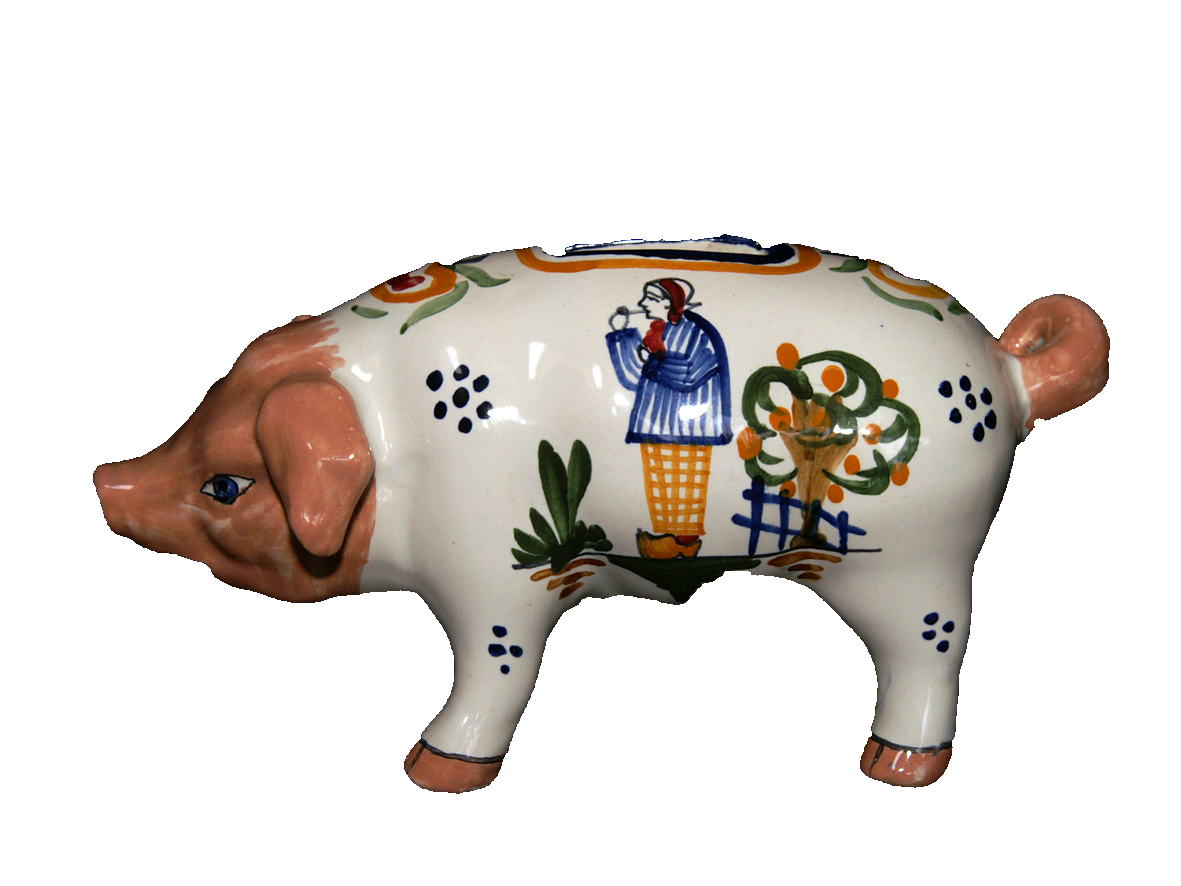
- The piggy banks made in mould 393 are 21 cm in length.
Mould 393 with traditional décor 'petit Breton' and 'floral à la touche' pattern

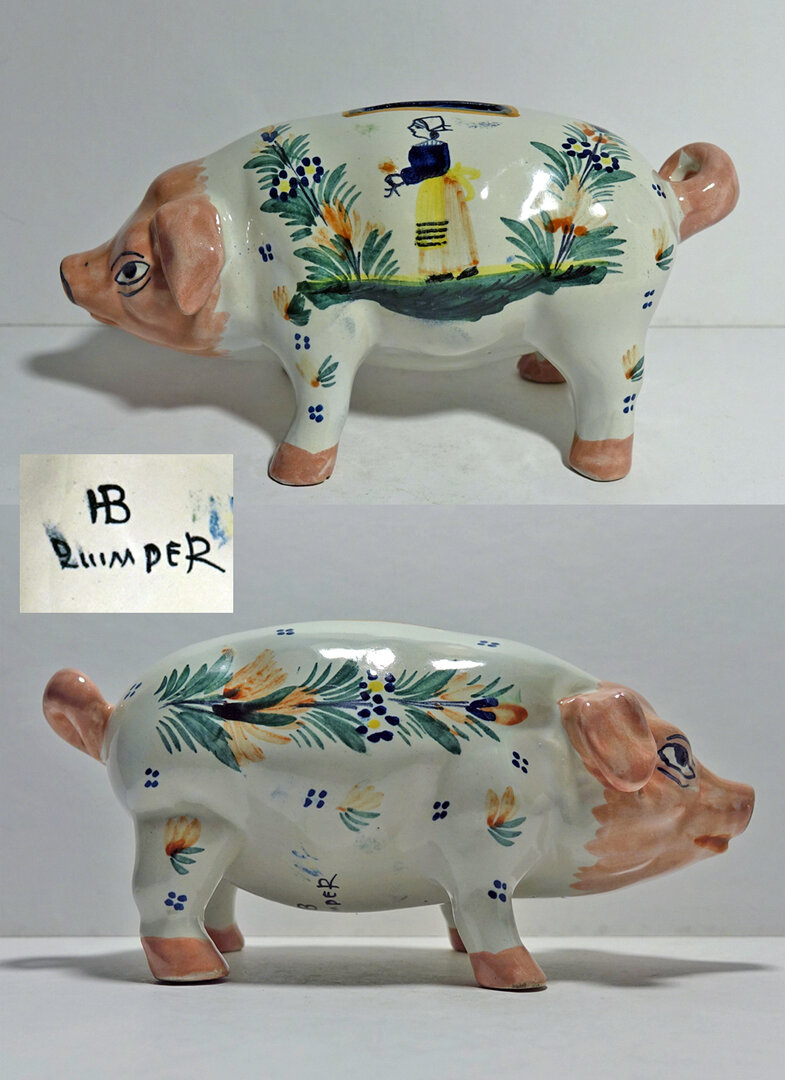
My oldest Quimper is this one. HB. Mould 33. This mark was used in the period 1883-1904. At that time, the painters used their own 'morse code'. Length 21 cm.



HB Quimper. Signature used between 1922-1968. Period of this: 1950-1968. Man and woman in typical Breton costumes. The man on the piggy bank "bears" the name Solange, the woman the name Marcel. That way they are connected.
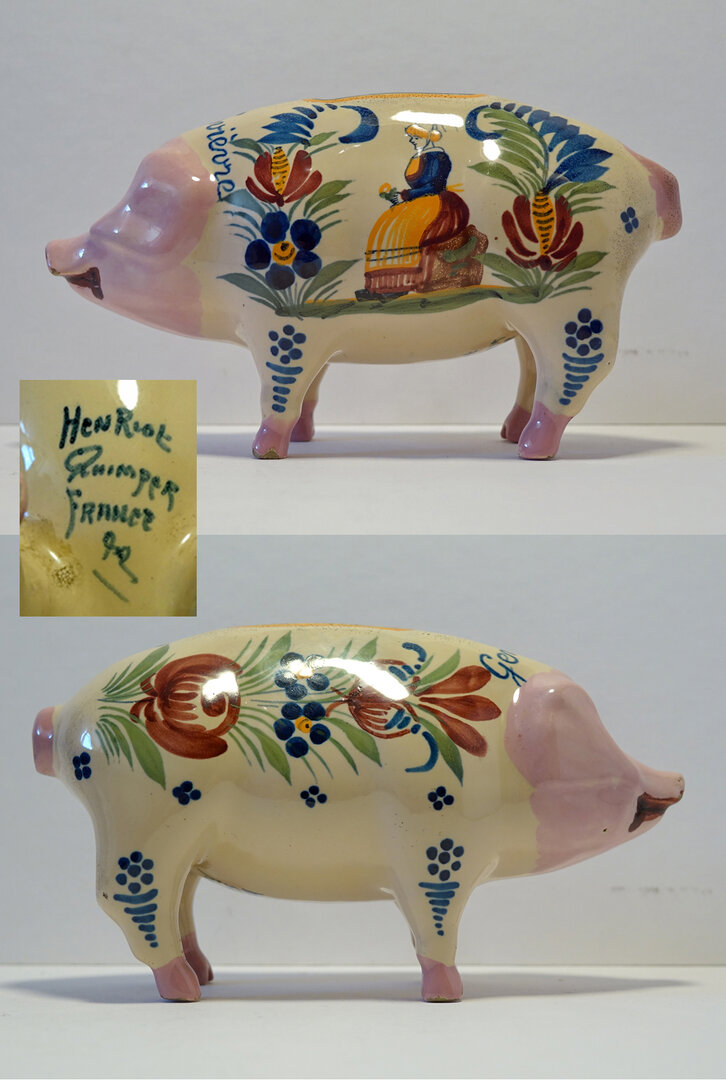
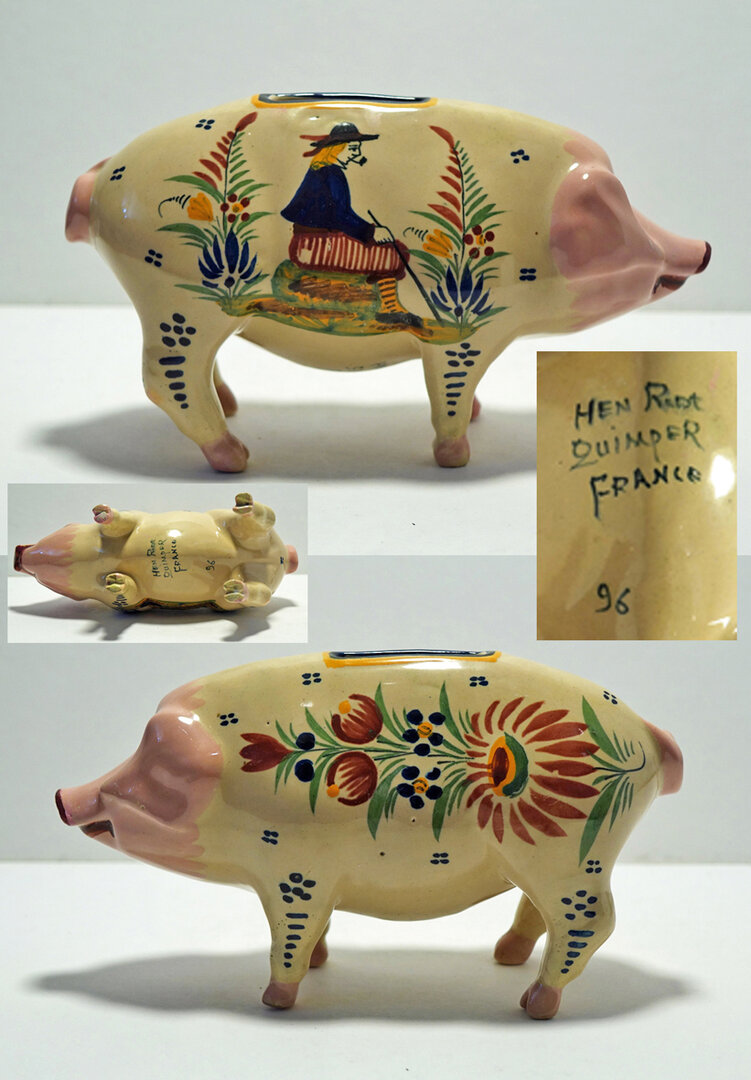
COMPARISON: TWO HB QUIMPER PIECES FEATURING A BRETON WOMAN
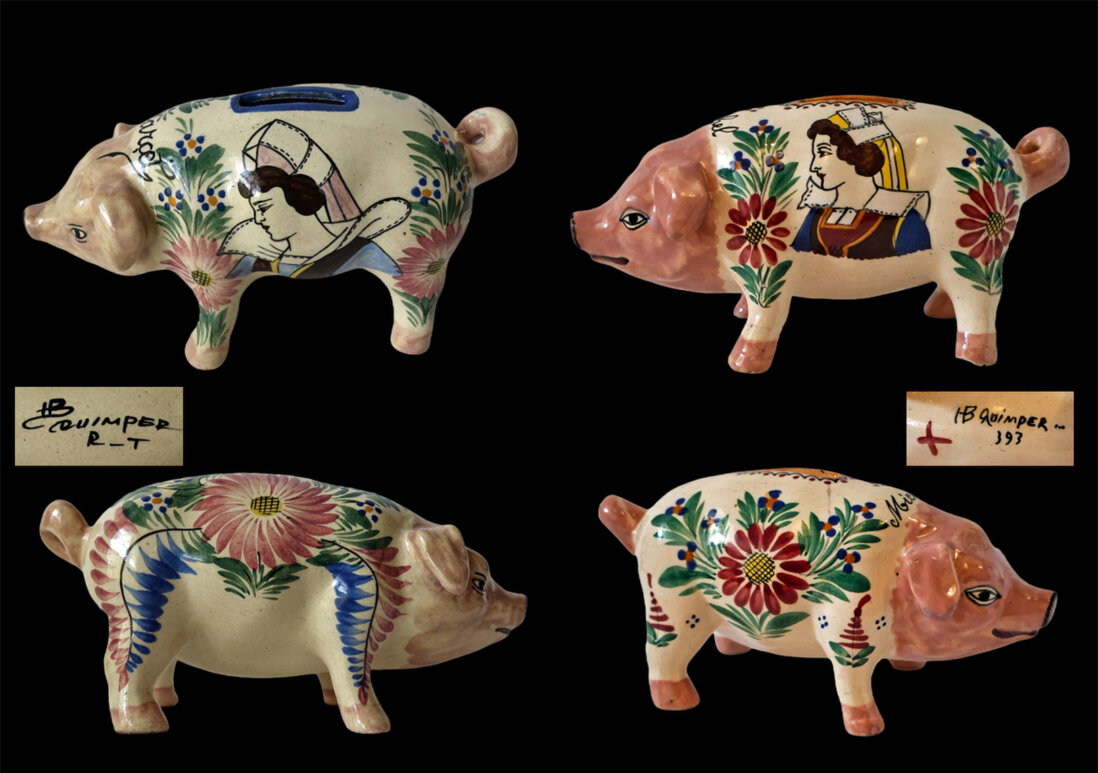
A comparison of two HB Quimper pieces featuring the “Woman in traditional Breton Costume” design. See picture above. The result of the comparison is shown in the photo.
How can there be such a significant difference? Is it due to the painter’s freehand style? Were there multiple charcoal stencils for the same design? I have no idea, and there is no one I can ask. It is clear, however, that the one on the left is older than the one on the right.
How can there be such a significant difference? Is it due to the painter’s freehand style? Were there multiple charcoal stencils for the same design? I have no idea, and there is no one I can ask. It is clear, however, that the one on the left is older than the one on the right.
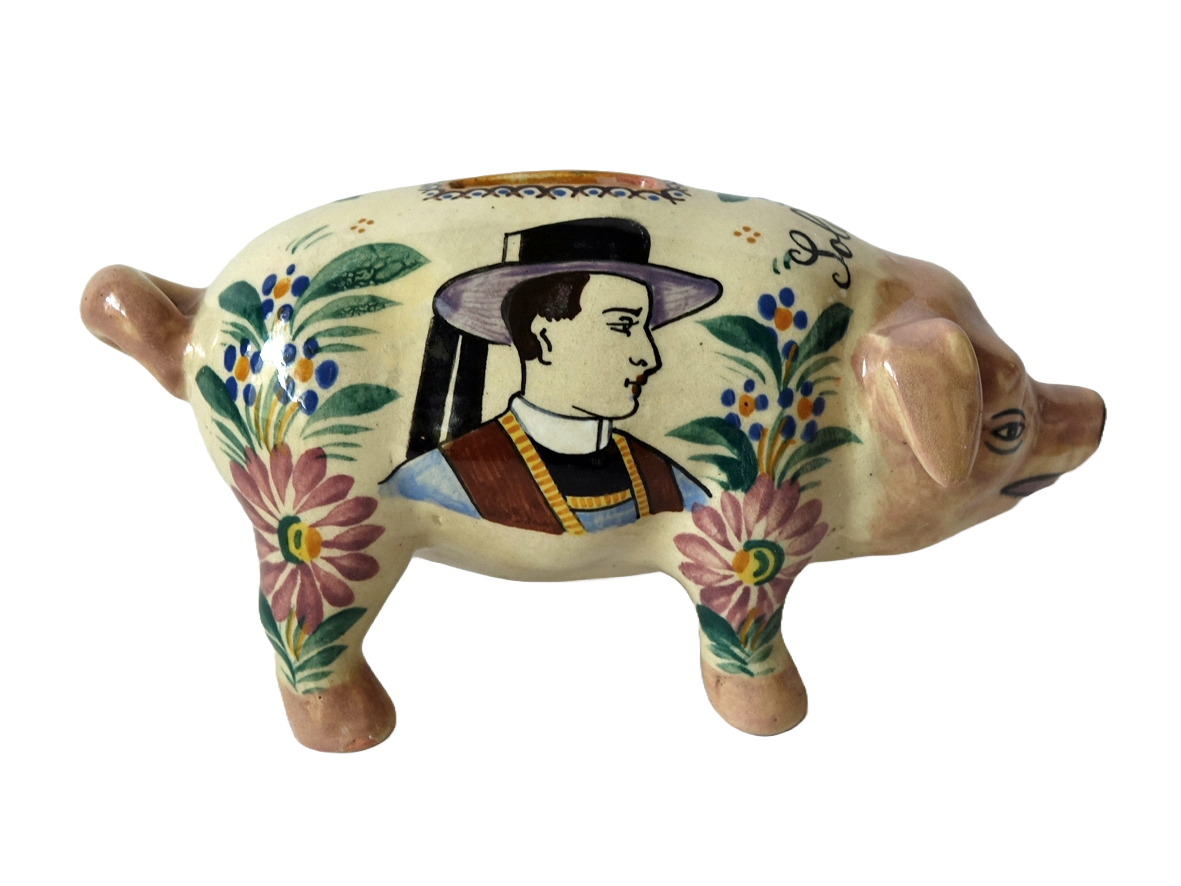
Not traditional, but also Quimper 393
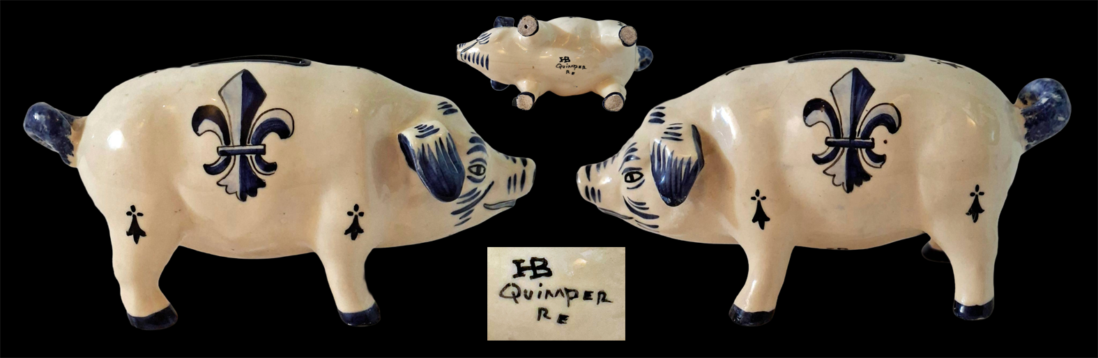
HB Quimper, period 1942–1968. Featuring a fleur-de-lis motif. This is not an unusual motif for HB Quimper, even though the manufacturer is best known for the 'Petit Breton' style and the 'floral à la touche' pattern. Regarding the letters in the mark: the 'R' stands for the workshop head Raymonde Pennaneac’h (1903–1969), and the 'E' for the painter/designer. The fleur-de-lis (also spelled *fleur-de-lys* or known as the 'French lily') is widely used in heraldry, where it is primarily associated with France—and, consequently, appears on piggy banks as well.
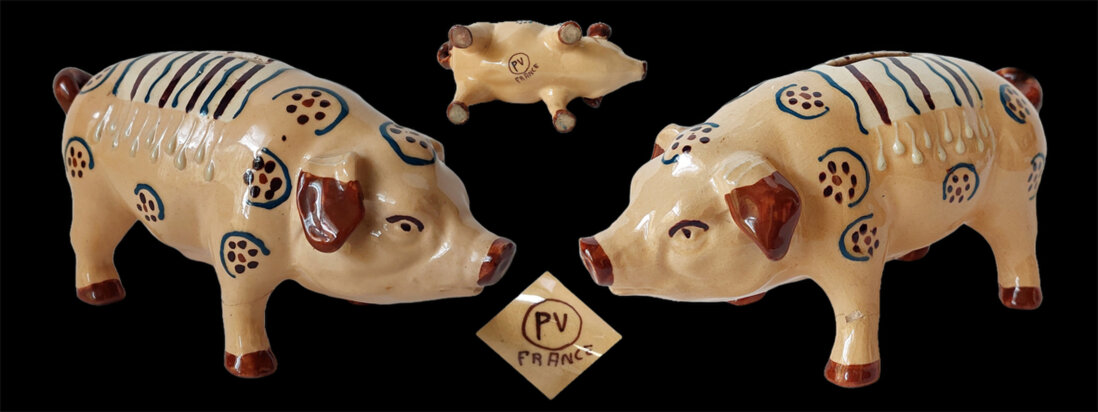
I found this piggy bank on eBay.com (the American eBay). Mould 393 is obvious. Could be from HB, but also from Henriot. But the brand is PV-France. How about that?
It turns out that Henriot (and/or HB) also worked with subcontractors. PARRY & VIEILLE was one of the companies involved in the production of Quimper faience. The collaboration with Henriot/HB took place around the 1920s to 1950s. This was a period when many pottery factories in Quimper collaborated or merged to optimize production and distribution. At P&V, the piggy banks were simply provided with the Henriot or HB mark. But here it seems (note: my theory!) that they also had their own line based on mould 393. They then decorated it according to their own insight. Because these did not meet Henriot / HB's standard, they made it their own brand. This seems to me a logical explanation for the PV brand under a Henriot/HB piggy bank. Period: 1920-1950. Length 21 cm.
It turns out that Henriot (and/or HB) also worked with subcontractors. PARRY & VIEILLE was one of the companies involved in the production of Quimper faience. The collaboration with Henriot/HB took place around the 1920s to 1950s. This was a period when many pottery factories in Quimper collaborated or merged to optimize production and distribution. At P&V, the piggy banks were simply provided with the Henriot or HB mark. But here it seems (note: my theory!) that they also had their own line based on mould 393. They then decorated it according to their own insight. Because these did not meet Henriot / HB's standard, they made it their own brand. This seems to me a logical explanation for the PV brand under a Henriot/HB piggy bank. Period: 1920-1950. Length 21 cm.
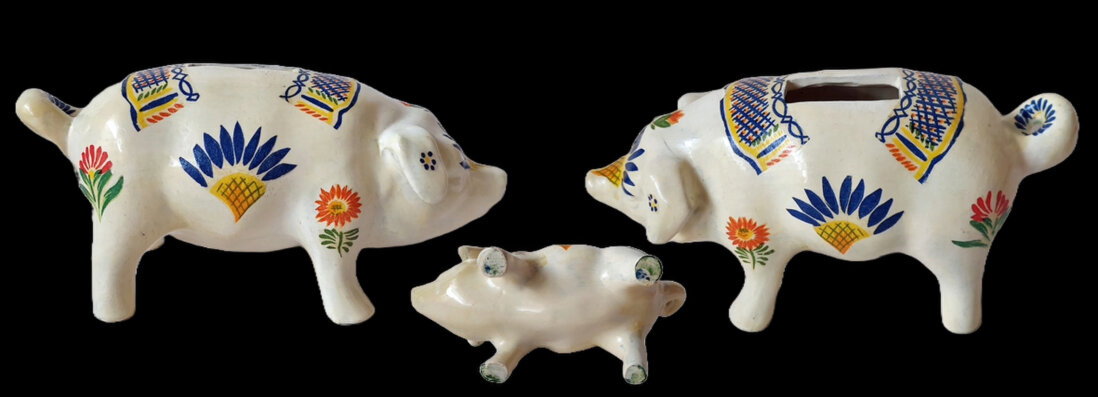
An unbranded, "signed all over" Quimper/HenRiot. 21 cm long. A less refined type of clay was used for this, it feels heavier and is somewhat coarser. And the motif/decoration is far from the traditional one we are used to from Quimper. Furthermore, the money slot is very wide; Whether this is conscious or an "accident" is impossible to say. It is also not clear who the maker is. The French seller marked it as Devres, but I doubt that.
Some more facts
The Kenilworth Studios brand is special, popular in the 1900s and 1930s. Kenilworth Studios was not a physical studio location in France, but rather a marketing brand or importer's name used for high-quality French pottery and porcelain of the early 20th century, often specifically associated with high-quality pottery from Longwy and Quimper. Pieces marked "Kenilworth Studios France" were produced in France, usually featuring art deco or traditional hand-painted designs (as at HenRiot Quimper) of the period. There is currently none in my collection with this marketing brand.
In the period 1950-1960, HenRiot also made ceramics on behalf of large retail chains in America, USA such as Marshall Field's Department Stores. The HenRiot brand has then been replaced by the name of the store chain. In terms of piggy banks they are 'signed all over' HenRiot Quimper.
The collaboration between HenRiot Quimper and Tiffany & Co. took place mainly between ca. 1920–1930. A number of piggy banks are known from this.
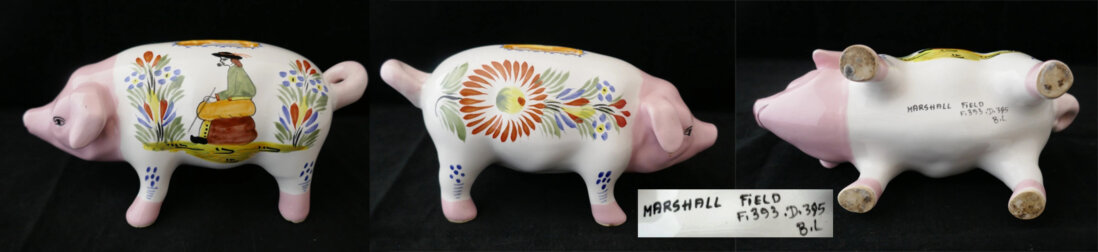
Found on eBay.com (USA), April 12, 2026. Made for Marshall Field's Department Stores. 'Quimper France' is not mentioned in the brand. Period 1950-1960. Not in my collection.

Found on eBay.com(USA), May 2024. "HenRiot Quimper for Tiffany & Co". The brand only mentions 'Quimper 'France', the number of the decor and the painter's initials. Period 1920 -1930. Not in my collection.
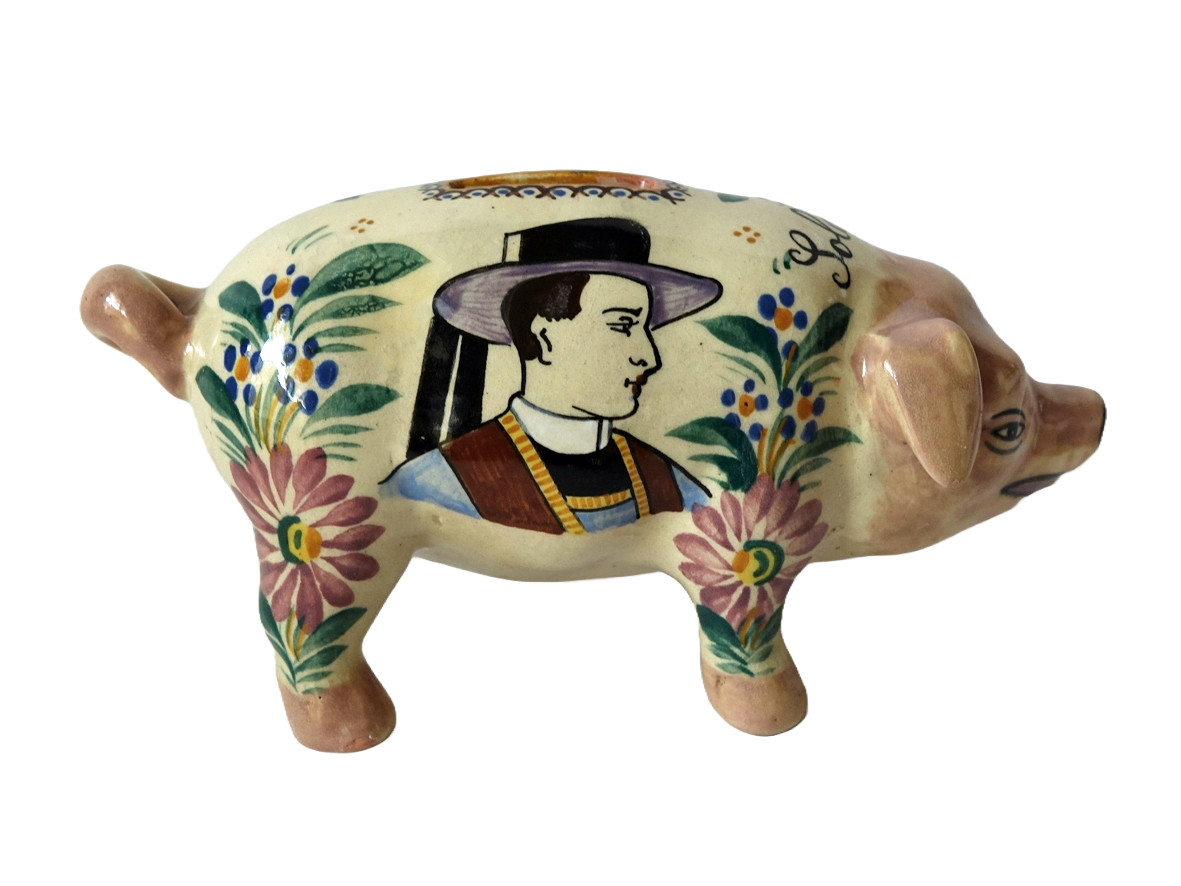
Quimper special editions
In addition to piggy banks out of mould 393, HenRiot (1922-1968) also made two other types. The grey one without a traditional décor (!) was probably made for export to the USA, an important customer of HenRiot. The other has the traditional Breton peasant décor. Of which I have both the farmer and the farmer's wife in my collection.

HenRiot Quimper. "The couple is united!". These collectibles, featuring the classic Quimper colors of pink, blue, yellow, and green, were produced in Brittany between 1922 and 1968. They were part of a less common series and are no longer in production. Length 17.5 cm.
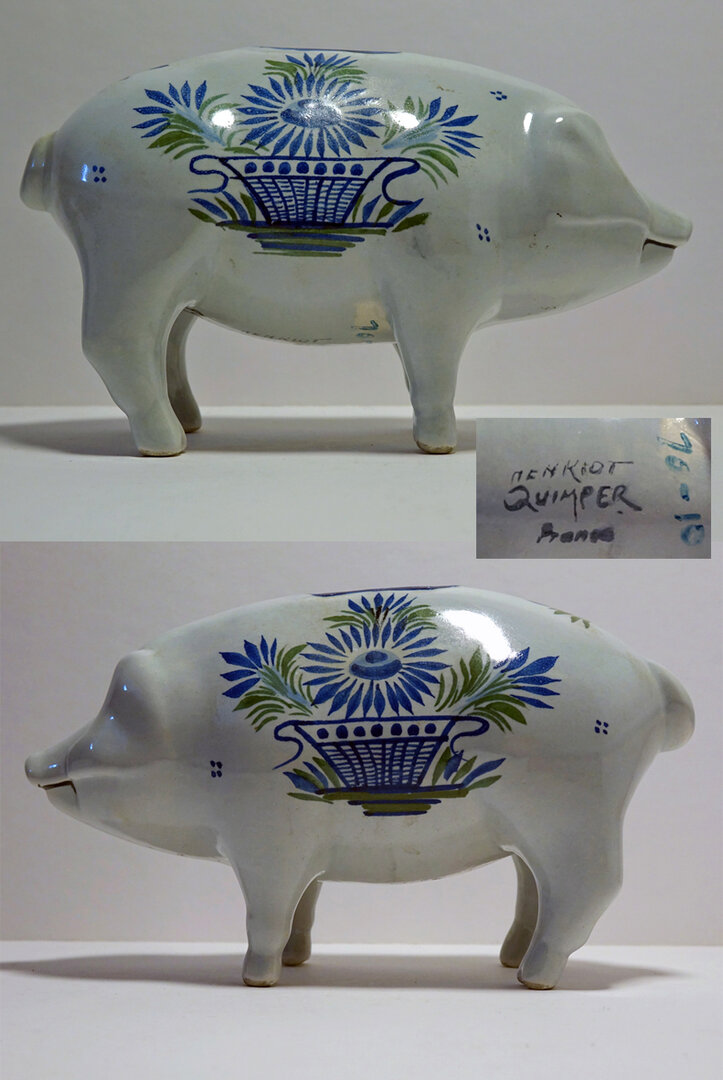

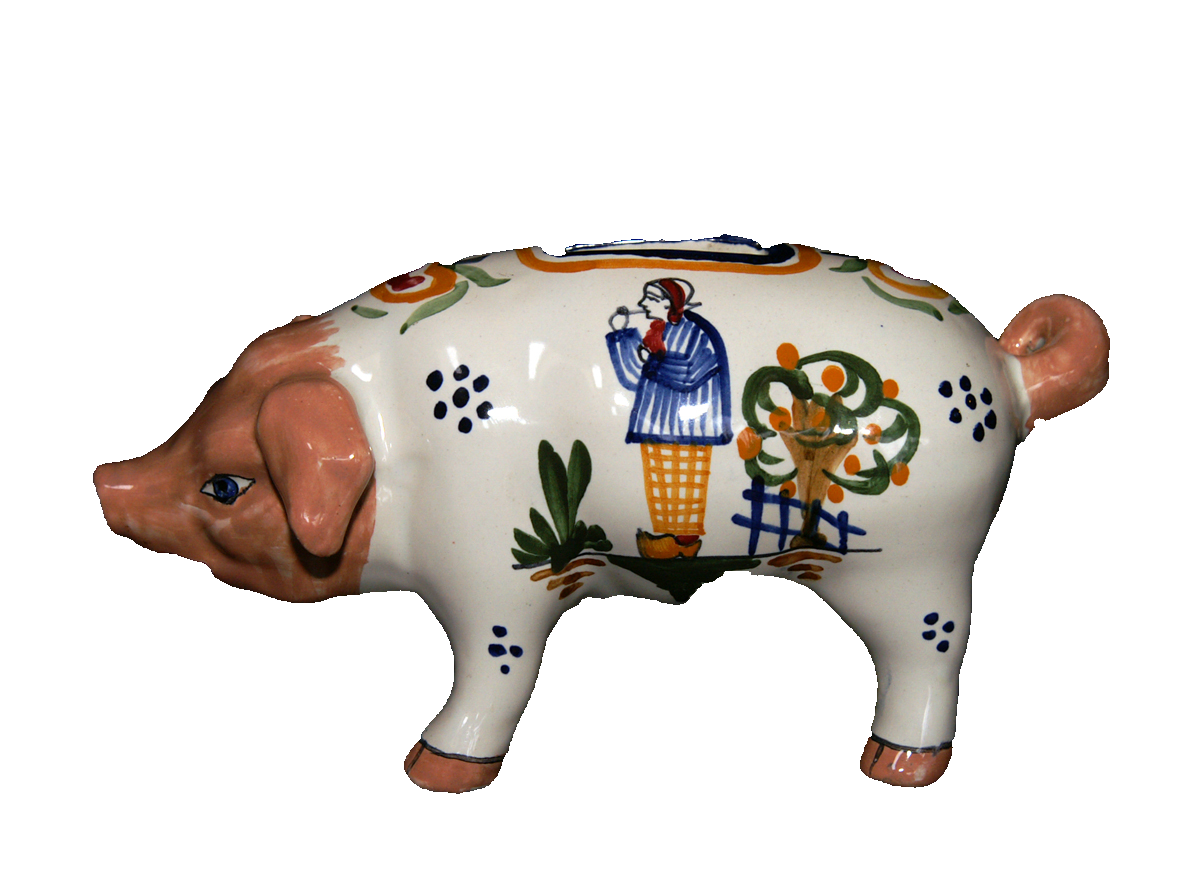
VB Normandie
Between 1922 and 1932, Jules Verlingue and Louis Bolloré registered the brand 'VB Normandie'. Jules Verlingue was director of HB Quimper and later owner of his own faience studio. Louis Bolloré was a business partner. Normandie refers to a decor line or series, not to the place of production. Production period: 1922–1932. Although VB Normadie was its own brand, the mold 393 was used for the piggy banks. Probably after consultation, or purchased. Molds were ultimately also a trade, albeit under conditions.
Where was it made? Probably in one of these contexts:
- HB Quimper (under Verlingue): Verlingue worked there until 1920, but then remained involved through registrations and models.
- Atelier Verlingue (Boulogne-sur-Mer): From 1920 he ran his own faience factory, where many regional decors were made.
- External workshops that worked under license: VB brands were sometimes used for regional series that were not necessarily produced in Brittany, but were subject to Verlingue's design or set rights.
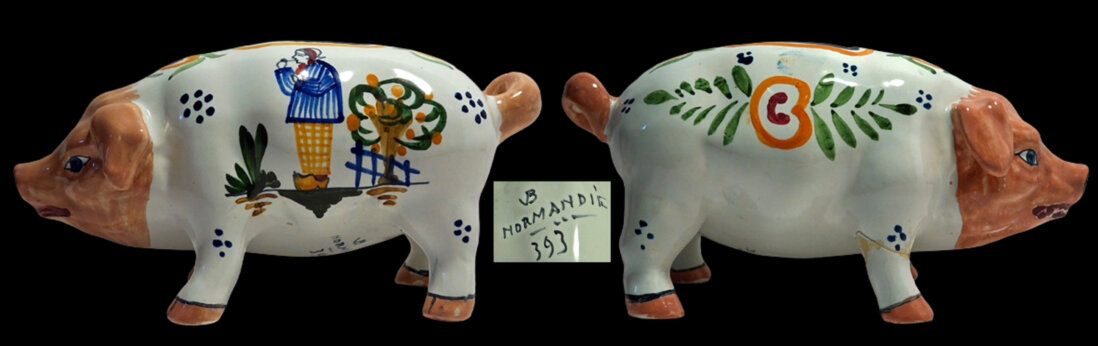
VB Normandy. With traditional Breton decor. And mold number 393 on the belly. The 'Morse code' can be traced back to the painter. Period 1922-1932.
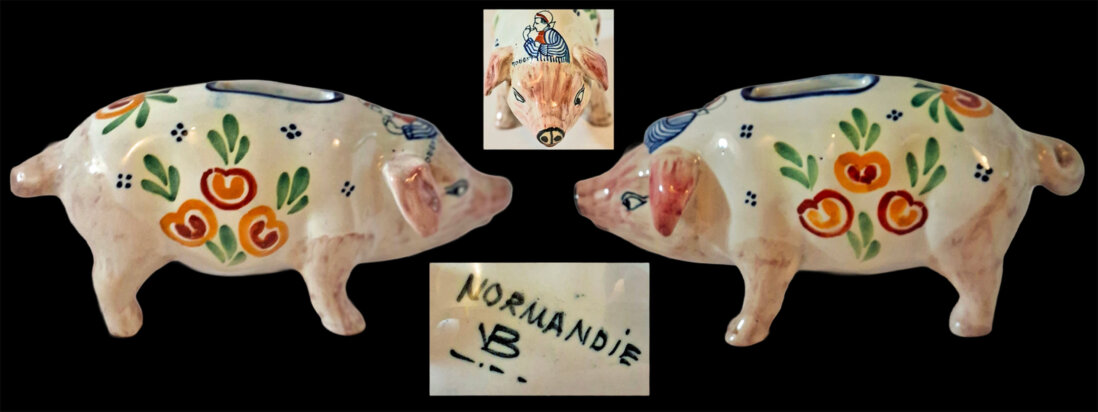
VB Normandy. Floral decor. With a farmer's wife in Norman costume on the head, which is special in itself. The text 'Toringy' refers to a village in Normandy. So small that you might wonder if this is a souvenir. Period 1922-1932.