More world/RU/ ???
Collection 2

More world/ Question marks
And more ....
“Miscellaneous”, the (small) residual group. In this section you can see piggy banks from different countries which for one reason or another were not hosted in the classification groups (sections) in the subsequent pages you've seen.


Russia
Russian pottery has a rich and fascinating history. The Russian Tsars, especially Catherine the Great, were great admirers of European porcelain, such as that of Meissen in Germany. Catherine the Great ordered similar high-quality porcelain to be produced in Russia, which led to the establishment of several important porcelain factories. The Russian porcelain industry was originally heavily influenced by European styles and techniques, especially those from Germany and France. The tsars and nobility often collected European porcelain, which inspired Russian manufacturers to achieve comparable quality and artistic value.
Major brands are: Lomonosov Porcelain Factory (Imperial Porcelain Factory); Dmitrov State Porcelain Factory (originally Gardner Porcelain Factory, founded in 1766 by English entrepreneur Francis Gardner); Kuznetsov Porcelain Factory; Dulyovo Porcelain Works and important for my piggy bank collection: Gzhel Porcelain Factory and Konakovo Faience Factory.


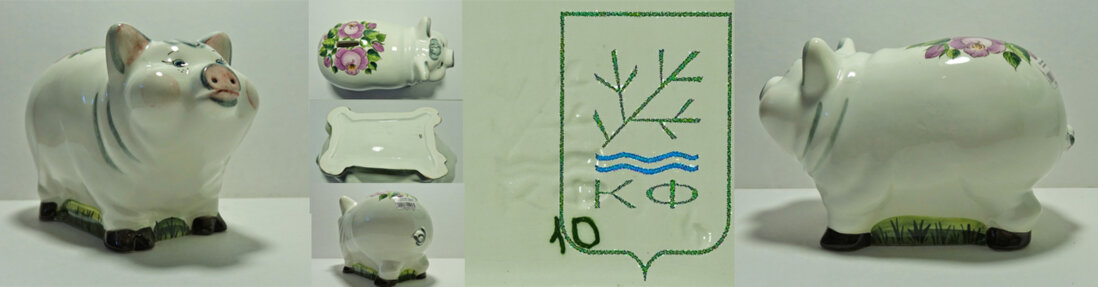
Made by KONOKOVO Faience. Based on the original mold from the USSR era (used from 1962-1974). Length 20.5 cm.

Question marks
"Where could they come from?". I really don't know!
If you should recognize one or more of the piggy banks that are shown here do not hesitate to send me an e-mail.
I would be grateful.


- Collection number 168: Purchased in PRAGUE in November 1993. Therefore assumed he was Czech. It is not!
- Collection number 1156: From a foreign collection (May 2020), origin unknown.
- Collection number 1189: This one contained Argentine banknotes. So Argentinian? Possible, but.......
For 1189 I looked at Argentine piggy bank sites and noticed one image of 1189 (in basic terracotta) with a history (Pygg clay…). Looked further at “terracotta” pig piggy banks on both Argentine and Spanish sites. Nothing found. Could mean that 1. I cannot search or cannot find; 2. that 1189 is old and no longer in production; 3. that he/she is not Argentinian or Spanish at all. For now I tend to have a Spanish or South American origin. Conclusion: 168 is certainly not Czech, as I have believed for almost 30 years..... And 1156 isn't Czech either.
